

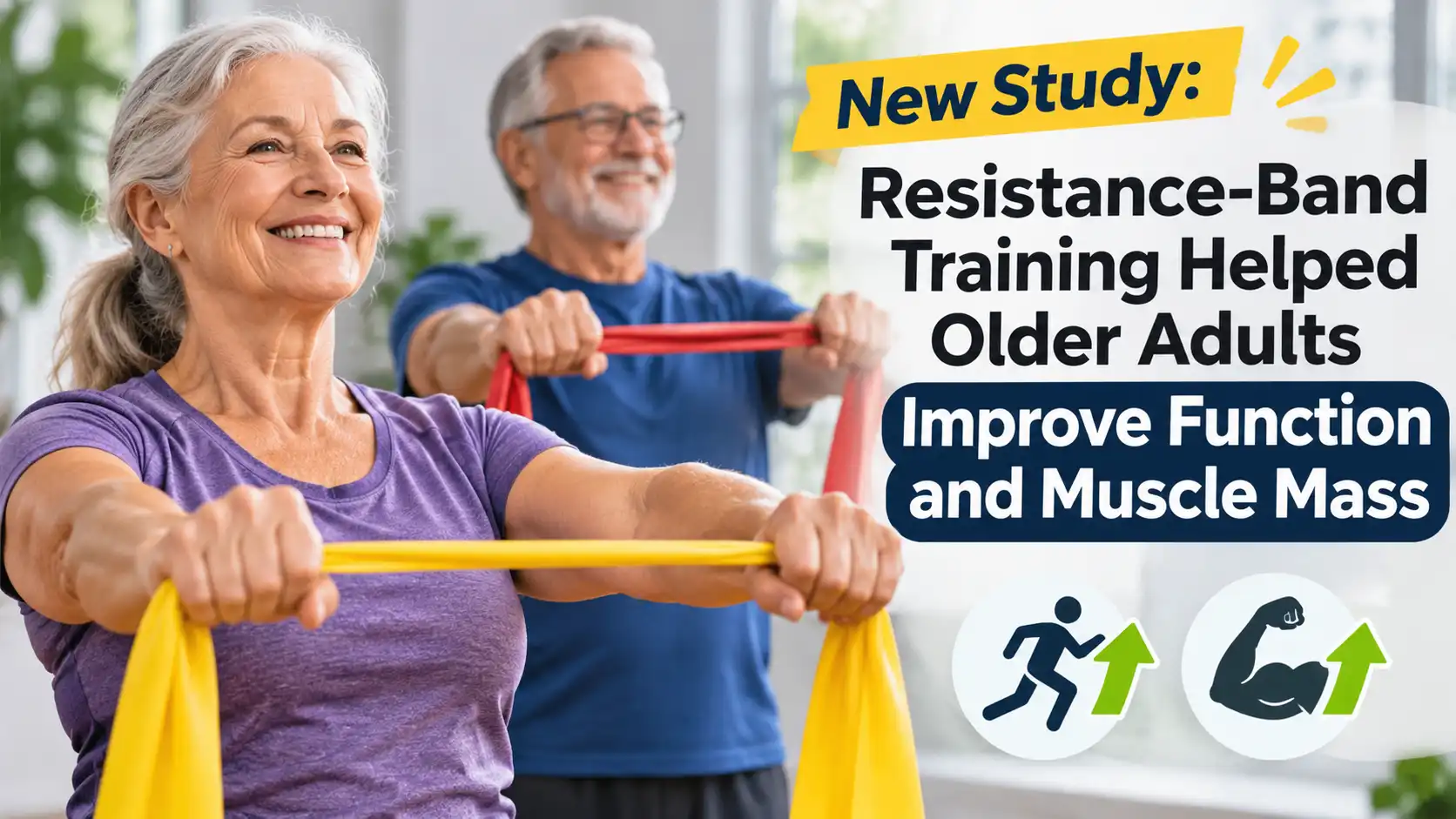
If you are getting older and the idea of lifting barbells or using gym machines feels intimidating, expensive or impractical, a new study offers some encouraging news. A randomized controlled trial published on November 23, 2026 suggests that resistance band training for older adults can improve physical function and increase muscle mass in community-dwelling older adults with early mobility limitations.
The study, published ahead of print in Experimental Gerontology, focused on older adults described as preclinically mobility-limited. According to the PubMed record for the trial, the authors concluded that their pragmatic resistance-band intervention increased physical function and D3-creatine-measured muscle mass.
That does not mean resistance bands are now proven equal to heavy gym training for every goal. It does mean bands may be more than a beginner placeholder for the right population, especially older adults who need a simpler and more accessible way to start strength training.
What changed
The news here is the publication of a new randomized controlled trial: A pragmatic resistance band intervention to improve physical function in community-dwelling older adults: A randomized controlled trial. It was listed on PubMed as published on November 23, 2026 and ahead of print.
For readers, the key update is practical: this study adds new evidence that a structured band-based program can help older adults improve how they move and may also help improve muscle mass, at least in this specific setting.
What the study found
Based on the published abstract information indexed on PubMed, the trial followed participants at Week 0, 6, 12 and 18. The population was made up of community-dwelling older adults with early mobility limitations.
The study tracked more than just one outcome. Secondary outcomes included strength, power, body composition, sarcopenia risk, frailty status, mobility, physical activity and health-related quality of life. The authors’ conclusion, as indexed publicly, was that the resistance-band program increased physical function and D3-creatine-measured muscle mass.
That matters because physical function is not just a lab number. For older adults, better function can mean moving more confidently, handling daily tasks more easily and maintaining independence longer. The muscle-mass finding is also notable because the authors used D3-creatine measurement, which is a more specific muscle-mass marker than simply looking at body weight alone.
Why this matters to home exercisers and older lifters
Many people assume strength training only “counts” if it happens with barbells, dumbbells or machines. This paper challenges that assumption, at least partly.
Resistance bands have clear real-world advantages. They are cheaper than a full home gym, easy to store, portable and often less intimidating for beginners. For older adults who are hesitant to train in a commercial gym, that lower barrier may matter a lot. That said, the study did not test consumer preference or cost savings directly. Those are practical inferences, not findings from the trial itself.
The more evidence-based takeaway is simpler: when delivered in a structured way, band training can be effective for older adults with early mobility limitations.
What readers should not assume
This is where the nuance matters.
- This was not a study on everyone. The participants were older adults with preclinical mobility limitation, not young lifters, competitive bodybuilders or advanced strength athletes.
- The abstract does not give a full program blueprint. The evidence supplied here does not confirm the exact exercise list, the number of sets and reps, the progression model, adherence rates or the size of the benefit versus a comparison condition.
- Bands are a tool, not magic. Results still depend on doing enough work, progressing over time and training consistently.
So if your goal is maximizing strength for powerlifting or building a bodybuilding-level physique, this study does not answer those questions. But if your goal is to start training safely and effectively as you age, it is a meaningful piece of evidence.
How this fits with broader resistance-training guidance
The bigger picture has not changed. Good strength training still revolves around progressive overload, regular practice and training the major muscle groups consistently.
That broader view is also supported by the American College of Sports Medicine. In its 2026 resistance-training guidance summary, ACSM recommends training major muscle groups at least two days per week and progressing gradually over time. You can see that in the organization’s 2026 resistance training infographic.
In other words, bands can fit the same basic principles that make other forms of resistance training work. The equipment does not remove the need for progression. It simply changes how that progression is delivered.
What this means in practice
For older adults, beginners and people training at home, this study supports a practical message: you do not necessarily need a full gym setup to start improving strength-related function.
If you are using resistance bands, the goal should still be a real training plan rather than random movements. A structured routine that covers the major muscle groups, is repeated consistently and becomes gradually more challenging is far more likely to help than occasional light exercise with no progression.
If you are unsure where to begin, it may also help to review basic training principles like full-body programming and progression. IronPinoy has already covered related fundamentals in guides such as 2-Day Full-Body Workout for Beginners and The Science Behind Progressive Overload.
The bottom line
This new study does not prove resistance bands are the best tool for every lifter. It does suggest they can be a legitimate strength-training option for older adults with early mobility limitations when used in a structured program.
That is a useful reminder for anyone who thinks strength training only starts once you have a barbell. For the right person, with the right plan, resistance bands may be enough to improve function and support muscle health.
The main caution is that the currently available abstract leaves out several programming details. So this is best read as strong early support for band-based training in a specific older population, not as a one-size-fits-all prescription.
