

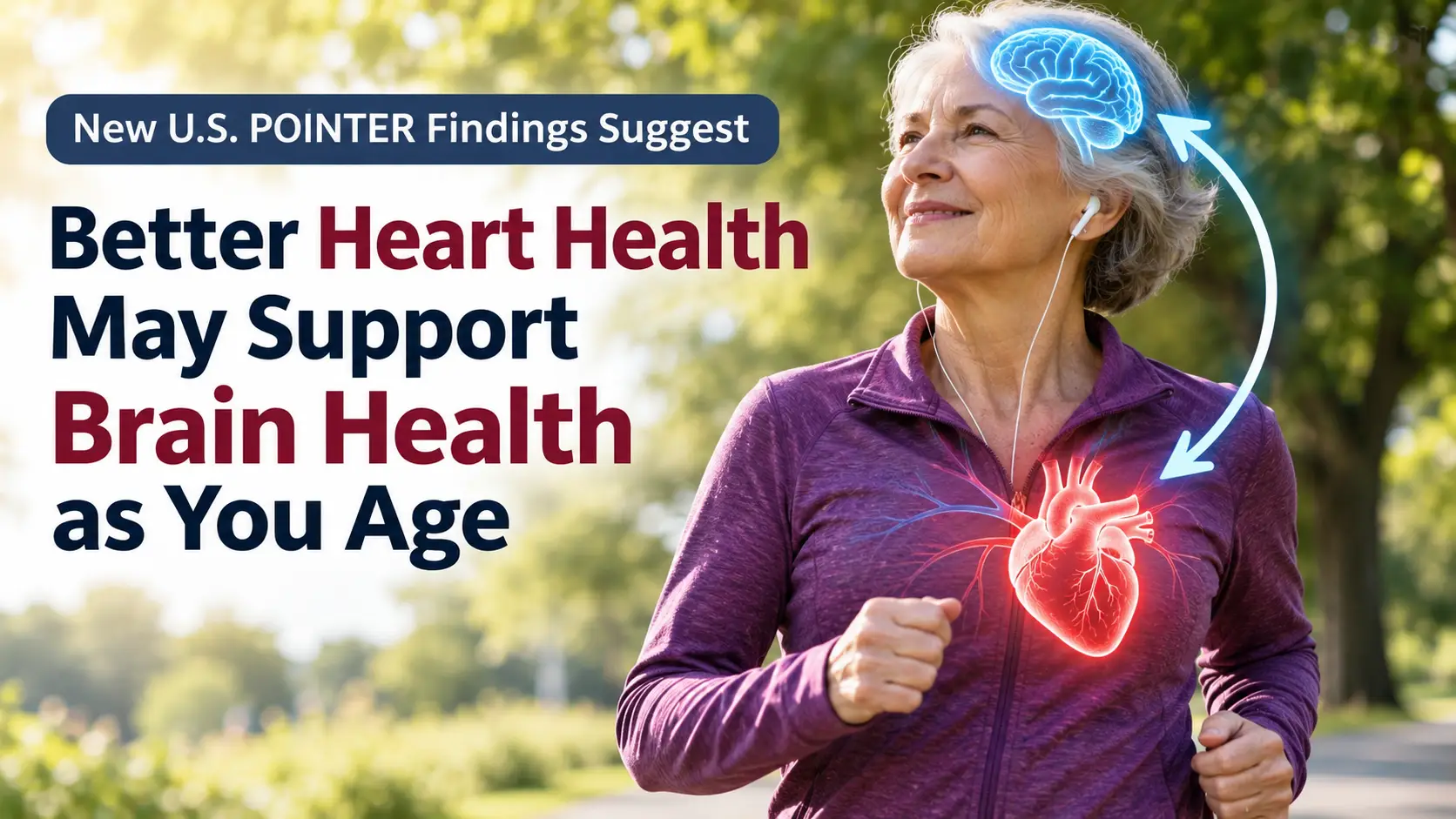
New findings from the U.S. POINTER study are adding weight to a message many adults already hear for healthy aging: what helps your heart and metabolism may also help your brain.
On November 18, 2026, the Alzheimer’s Association announced new results from U.S. POINTER at the Clinical Trials on Alzheimer’s Disease (CTAD) conference in Boston. According to the announcement, older adults in a more structured lifestyle program showed bigger improvements in several cardiometabolic markers than those in a self-guided program, and those improvements were linked with better cognitive outcomes over two years. The same announcement also said the organization will invest more than $40 million over the next four years to continue follow-up through the U.S. POINTER Alumni Extension.
That update builds on the main U.S. POINTER randomized trial, which was published in JAMA in 2025. In that earlier paper, both study groups improved global cognition over two years, but the structured, higher-support program produced a statistically greater benefit than the self-guided approach.
What changed in the new U.S. POINTER update?
The fresh news is not the original trial itself. It is the newly announced analysis linking better cardiometabolic health with better brain outcomes, plus the extension of follow-up.
In the Alzheimer’s Association announcement, the structured program was reported to produce significantly greater reductions in:
- Body mass index
- Waist circumference
- HbA1c
- Diastolic blood pressure
- Resting heart rate
- Total cholesterol
- LDL cholesterol
- Triglycerides
The announcement also said that participants who improved more on these measures tended to improve more on cognition over the two-year period. You can read the organization’s summary here: Alzheimer’s Association U.S. POINTER announcement.
What the study included
U.S. POINTER was a phase 3, five-site, two-year, single-blind randomized clinical trial involving 2,111 adults ages 60 to 79. Participants were considered at elevated risk of cognitive decline because of modifiable factors including sedentary lifestyle, suboptimal diet, and cardiometabolic risk.
They were randomized to one of two active programs:
- Structured, higher-support lifestyle program
- Self-guided lifestyle program
Both programs targeted physical activity, diet, cognitive and social engagement, and health monitoring. The main difference was the intensity of support and accountability.
That point matters. This was not a trial of “healthy habits versus doing nothing.” It compared two active approaches, which makes the new findings more useful for real-world behavior change but also means readers should avoid overreading the results.
Why this matters for adults 40+
For ActivePinoy readers, the practical takeaway is simple: brain health may not be separate from the daily habits that already matter for active aging.
Exercise, healthier eating, waist management, blood pressure control, blood sugar control, and healthier cholesterol are often discussed as heart-health goals. These new U.S. POINTER findings suggest they may also move in the same direction as better cognitive health in older adults.
That does not mean any single workout, supplement, or diet pattern can prevent Alzheimer’s disease. The evidence here supports a broader lifestyle pattern, not a miracle fix. It also supports consistency. A structured program with more follow-through did better than a looser, self-guided version.
For many Filipino adults in midlife and beyond, that may be the most useful lesson: habits work better when they are organized, monitored, and sustained.
What this can look like in real life
The study announcement does not prescribe a specific Filipino meal plan or gym routine, so it would be a mistake to claim one exact formula. But the overall direction is clear: improve physical activity, diet quality, and key health markers over time.
That may mean:
- Following a regular exercise schedule instead of relying on random bursts of activity
- Paying attention to waist size, not just body weight
- Monitoring blood pressure, blood sugar, and lipid levels during routine checkups
- Using structure and accountability, such as a coach, training partner, class, or written plan
- Thinking in years, not weeks
If you are already working on strength and movement capacity, that still fits the bigger picture of healthy aging. Readers who want a practical fitness starting point may also find our guide on how to start strength training after 50 helpful, and we’ve previously covered the broader connection between exercise and brain function.
Important limits to keep in mind
This is a strong and relevant update, but it is not the last word.
| What we know | What remains uncertain |
|---|---|
| The main U.S. POINTER trial was peer-reviewed and published in JAMA in 2025. | The newly announced cardiometabolic-cognition analysis appears to be conference-reported through a press release, not a separate peer-reviewed paper in the supplied material. |
| The structured program improved cognition more than the self-guided program in the main trial. | The new announcement reports that better risk-factor changes were linked with better cognition, but linkage alone does not prove each specific change directly caused the cognitive benefit. |
| The participants were older adults with modifiable risk factors. | Further work is still needed on long-term sustainability, functional outcomes, biomarkers, and clinical relevance. |
In short, the message is promising, practical, and relevant to healthy aging. But it is still smarter to talk about risk reduction and support for brain health, not guaranteed prevention.
What to watch next
The extension phase may become just as important as the original study. Longer follow-up could help clarify whether the benefits hold up over time and whether short-term improvements in cognition and cardiometabolic health translate into more meaningful long-term outcomes.
For now, the most useful reading of the news is this: a structured lifestyle approach appears to improve both metabolic health markers and cognitive outcomes in older adults at risk of decline, and the two seem to move together.
FAQ
Does this prove exercise prevents dementia?
No. The findings support an association between structured lifestyle improvement, better cardiometabolic health, and better cognitive outcomes. They do not prove that one specific exercise habit prevents dementia.
Who were the participants in U.S. POINTER?
Adults ages 60 to 79 who were at elevated risk of cognitive decline because of modifiable factors such as low physical activity, suboptimal diet, and cardiometabolic risk.
What is the main practical takeaway?
Focus on sustainable habits: regular physical activity, better diet quality, waist management, and routine monitoring of blood pressure, blood sugar, and cholesterol. Structure and consistency appear to matter.
Why is the structured program important?
Because the main trial found greater benefit with a higher-support, more accountable approach than with a self-guided one. That suggests follow-through may be part of the benefit.
