

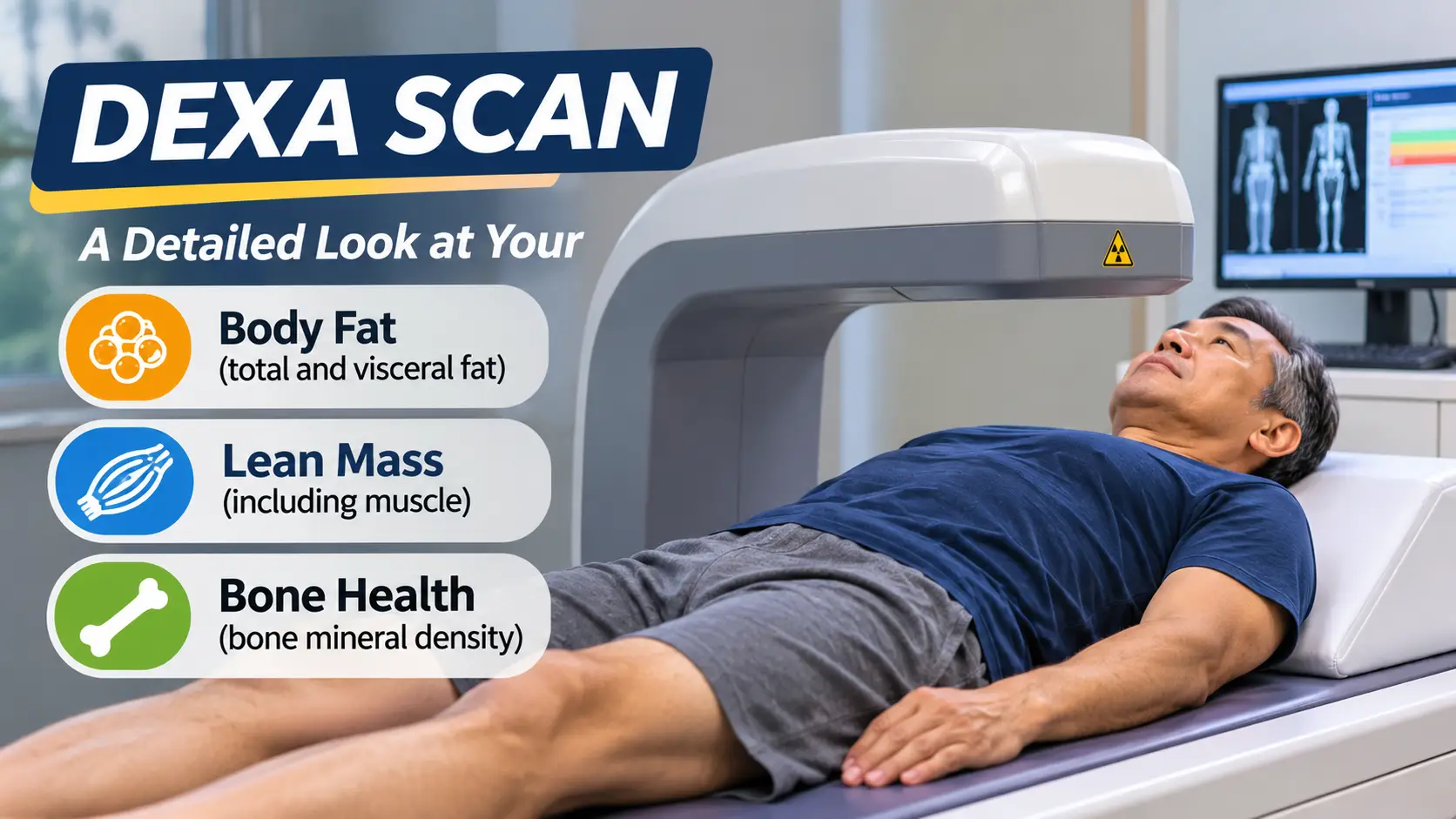
You step on the weighing scale and see that your weight has barely changed. But your clothes fit differently, your waist looks smaller, and you’re lifting heavier weights at the gym.
Are you losing fat? Building muscle? Or simply maintaining your weight?
A regular weighing scale cannot tell you.
This is where a DEXA scan, also called a DXA scan, becomes useful.
Originally developed to measure bone density and help diagnose osteoporosis, DEXA technology can also provide a detailed picture of body composition. With the appropriate equipment and software, it can estimate how much fat and lean tissue you carry and where these tissues are distributed throughout your body.
For adults over 40, particularly those trying to maintain muscle, reduce abdominal fat, and protect their bones as they age, this information can be valuable.
However, DEXA is not a perfect measurement, and not everyone needs one.
This guide explains how DEXA works, what the results mean, how it compares with other body composition tests, and when getting scanned may be worthwhile.
What Is a DEXA Scan?
DEXA stands for Dual-Energy X-ray Absorptiometry.
It is a medical imaging technique that uses two low-energy X-ray beams to measure how different tissues absorb radiation.
Because bone, fat, and lean soft tissue absorb X-rays differently, specialized software can estimate their amounts.
DEXA has two main applications:
1. Bone density assessment
A clinical bone density scan measures bone mineral density, usually at the hip and lumbar spine. Doctors use this information to diagnose osteoporosis, estimate fracture risk, and monitor treatment.
2. Whole-body composition assessment
A whole-body DEXA scan can estimate total body fat, lean soft tissue, bone mineral content, and regional body composition.
Although both use the same underlying technology, a routine hip-and-spine bone density scan does not automatically include a full-body composition analysis.
If your main goal is to measure muscle and fat, specifically request a whole-body DEXA body composition scan.
What Does a DEXA Body Composition Scan Measure?
A whole-body DEXA report can provide substantially more information than body weight alone.
1. Total Body Fat Percentage
Body fat percentage represents the proportion of your body weight made up of fat.
For example, consider a person weighing 75 kilograms with 28% body fat.
Their estimated fat mass would be:
75 × 0.28 = 21 kilograms of fat
The remaining 54 kilograms includes lean soft tissue and bone mineral content.
Unlike BMI, body fat percentage helps distinguish between people of similar height and weight who have different body compositions.
However, no single body fat percentage guarantees good health. Age, sex, fat distribution, metabolic health, and physical fitness also matter.
2. Total Fat Mass
DEXA estimates total fat mass in kilograms.
This measurement can be particularly useful during a fat-loss program.
Suppose someone starts with 23 kilograms of fat and records 19 kilograms several months later.
That represents an estimated reduction of four kilograms of fat, assuming the difference exceeds the scanner’s measurement uncertainty.
This is more informative than knowing only that body weight decreased.
3. Lean Body Mass
DEXA also measures lean soft tissue.
This includes:
- Skeletal muscle
- Organs and other nonfat soft tissues
- Water within lean tissues
- Blood and connective tissue
An important distinction is that DEXA lean mass is not the same as pure skeletal muscle mass.
For example, a report showing 50 kilograms of lean tissue does not mean the person has 50 kilograms of skeletal muscle.
Hydration, glycogen storage, inflammation, and recent exercise can also affect lean tissue estimates.
4. Regional Body Composition
One of DEXA’s useful features is the ability to estimate fat and lean tissue in different body regions.
These commonly include the arms, legs, and trunk.
For someone following a resistance training program, regional measurements may help reveal changes that body weight alone cannot show.
For example, a person may maintain the same overall weight while showing increased leg lean mass and reduced trunk fat.
Regional data can also help identify meaningful differences between the left and right sides, although these findings require careful interpretation.
5. Visceral Fat
Visceral fat is the fat located deep within the abdominal cavity, surrounding internal organs.
It differs from subcutaneous fat, which lies directly beneath the skin.
Excess visceral fat is associated with greater risk of several metabolic conditions, including type 2 diabetes and cardiovascular disease.
Some DEXA systems can estimate visceral adipose tissue, often abbreviated as VAT.
However, not all DEXA machines provide VAT measurements, and the result is a model-based estimate rather than a direct CT or MRI measurement.
There is also no universally accepted DEXA VAT cutoff that applies to every adult.
For people concerned about abdominal fat, waist circumference, blood pressure, blood glucose, and cholesterol remain important alongside any DEXA results.
6. Bone Mineral Density
Bone mineral density, or BMD, describes the mineral content of bone relative to the area measured.
A dedicated bone density examination helps doctors identify low bone mass and osteoporosis.
Bone health becomes increasingly important with age because lower bone density can increase fracture risk.
This is especially relevant after menopause, although men can develop osteoporosis too.
Why DEXA Scans Matter More as We Age
Aging changes body composition, even when body weight stays relatively stable.
Many adults gradually lose muscle mass and strength, accumulate abdominal fat, and experience changes in bone density.
These changes can affect mobility, physical independence, metabolic health, and quality of life.
Age-Related Muscle Loss
Sarcopenia refers to an age-related muscle disorder involving reduced muscle strength and muscle quantity or quality.
Low muscle mass is one component, but strength and physical performance are also important.
A DEXA scan can help estimate appendicular lean mass, which represents the combined lean soft tissue of the arms and legs.
Clinicians sometimes calculate the appendicular lean mass index:
Appendicular Lean Mass Index = Arm and Leg Lean Mass ÷ Height²
This can support an assessment for low muscle mass.
However, DEXA alone cannot diagnose sarcopenia. Grip strength, walking speed, chair-rise performance, and clinical assessment may also be necessary.
Abdominal Fat and Metabolic Health
As people get older, fat distribution often changes.
Some adults notice a larger waist even without substantial weight gain.
This can reflect changes in abdominal fat, including visceral fat.
For adults in their 40s, 50s, and 60s, tracking waist circumference alongside body composition may be more informative than focusing only on kilograms lost.
Bone Loss and Osteoporosis
Bone density can decline with age, particularly after menopause.
Osteoporosis may develop without obvious symptoms until a fracture occurs.
A dedicated DEXA bone density examination can identify reduced bone density before a fracture happens.
This makes DEXA especially valuable for people with established osteoporosis risk factors.
DEXA Scan vs. BMI: Which Is Better?
Body mass index, or BMI, is calculated using weight and height.
BMI = Weight (kg) ÷ Height (m)²
BMI is inexpensive, convenient, and useful for population-level screening.
However, it cannot distinguish fat mass from muscle mass.
Consider two hypothetical men:
| Measurement | Person A | Person B |
|---|---|---|
| Height | 170 cm | 170 cm |
| Weight | 75 kg | 75 kg |
| BMI | 26.0 | 26.0 |
| Body fat | 18% | 30% |
| Fat mass | 13.5 kg | 22.5 kg |
Both have the same BMI, yet their body compositions are substantially different.
A DEXA body composition scan could help distinguish these differences.
That does not make BMI useless. BMI, waist circumference, blood pressure, and other health measurements still provide valuable information.
The best approach is to interpret these measurements together.
DEXA Scan vs. InBody and Smart Scales
Many gyms and fitness centers use bioelectrical impedance analysis, commonly called BIA.
Devices such as InBody machines and consumer smart scales estimate body composition by passing a small electrical current through the body.
They are convenient, but their estimates can be influenced by hydration and testing conditions.
| Feature | DEXA | InBody / BIA | BMI |
|---|---|---|---|
| Body fat estimate | Yes | Yes | No |
| Regional lean tissue | Yes | Device-dependent | No |
| Bone mineral density | With appropriate DXA protocol | No | No |
| Visceral fat estimate | Some systems | Some systems | No |
| Radiation exposure | Very low | None | None |
| Convenience | Requires scanning facility | Often available in gyms | Very high |
| Cost | Usually higher | Usually lower | Free |
| Useful for tracking trends | Yes | Yes, with consistent conditions | Limited |
Is DEXA More Accurate Than InBody?
DEXA is generally considered a well-established reference method for body composition assessment, but it is not an error-free gold standard for every measurement.
BIA accuracy varies depending on the device, prediction equations, body type, and testing conditions.
DEXA also has limitations related to tissue hydration, scanner calibration, positioning, and software.
For someone already using an InBody machine regularly, there may be no need to abandon it.
Instead, use the same device under similar conditions and focus on meaningful trends rather than individual readings.
How Accurate Is a DEXA Scan?
DEXA can provide precise and reproducible measurements when performed correctly.
However, accuracy and precision are different.
Accuracy describes how close a measurement is to the true value.
Precision describes how consistently a measurement can be repeated.
A DEXA machine may produce consistent results while still having some systematic measurement error.
Several factors can affect results:
- Changes in hydration
- Recent strenuous exercise
- Food and fluid intake
- Glycogen fluctuations
- Body positioning
- Scanner calibration
- Different equipment manufacturers
- Software updates
For example, a small increase in estimated lean mass after a week of training does not necessarily mean new muscle tissue has developed.
It may partly reflect changes in water or glycogen.
The International Society for Clinical Densitometry recommends that facilities assess measurement precision and use appropriate procedures when comparing body composition results.
The practical lesson: Look for sustained changes over time rather than treating every decimal point as meaningful.
How to Prepare for a DEXA Scan
Preparation depends on whether you are undergoing a bone density test or a whole-body composition scan.
For a standard bone density examination, preparation is usually simple.
You may be asked to:
- Wear comfortable clothing without metal fasteners.
- Remove jewelry or other metal objects.
- Avoid calcium supplements for at least 24 hours before the test, according to the facility’s instructions.
- Inform the technologist if you recently underwent an imaging procedure involving contrast material.
- Tell the healthcare team if you are pregnant or may be pregnant.
For body composition testing, consistency is particularly important.
Try to schedule repeat scans at a similar time of day and follow the facility’s guidance on meals, hydration, and exercise beforehand.
Avoid intentionally dehydrating yourself to produce a different body fat reading.
If possible, use the same facility and scanner for follow-up assessments.
What Happens During a DEXA Scan?
A DEXA scan is generally quick, painless, and noninvasive.
Step 1: Registration and Preparation
You may complete a health questionnaire and remove items that could interfere with the scan.
Step 2: Positioning
You lie on a padded examination table while the technologist positions your body.
For bone density testing, your legs or feet may be placed in supports to ensure correct positioning.
Step 3: Scanning
A scanning arm moves over the relevant part of your body.
The machine uses low-dose X-rays to collect measurement data.
You must remain still during the scan.
Step 4: Analysis
Specialized software processes the data and generates measurements.
Step 5: Results
A radiologist or qualified healthcare professional interprets medical bone density findings.
For body composition scans, the facility may provide a separate report showing fat mass, lean mass, and regional measurements.
Most routine examinations take approximately 10–30 minutes, depending on the equipment and scanning protocol.
Understanding Your DEXA Scan Results
DEXA results vary according to the type of examination.
Understanding a Body Composition Report
A whole-body report may include:
| Measurement | What It Tells You |
|---|---|
| Total body fat % | Estimated proportion of body weight that is fat |
| Fat mass | Estimated total fat tissue in kilograms |
| Lean mass | Estimated nonfat soft tissue |
| Bone mineral content | Estimated mineral content of bone |
| Appendicular lean mass | Lean tissue in the arms and legs |
| Android/gynoid ratio | Comparison of abdominal-region and hip-region fat |
| Visceral adipose tissue | Estimated deep abdominal fat, if supported |
No single measurement should determine whether your health is improving.
For example, a small increase in lean mass becomes more convincing when accompanied by improved strength, better physical performance, and consistent measurements over time.
Understanding Bone Density T-Scores
A bone density report commonly includes a T-score.
The T-score compares bone density with that of a healthy young-adult reference population.
For postmenopausal women and men aged 50 and older, the commonly used diagnostic categories are:
| T-score | Classification |
|---|---|
| -1.0 or higher | Normal bone density |
| Below -1.0 but above -2.5 | Low bone mass (osteopenia) |
| -2.5 or lower | Osteoporosis |
These thresholds apply to appropriate skeletal sites and patient groups. They should not automatically be used for younger adults, premenopausal women, or every type of DEXA measurement.
A clinician must also consider previous fractures, medications, medical conditions, and overall fracture risk.
What Is a Z-Score?
A Z-score compares bone density with that of people of a similar age and sex, using the relevant reference data.
It is particularly useful in younger adults and certain clinical situations.
An unexpectedly low Z-score may prompt further investigation into possible causes of reduced bone density.
Who Should Consider Getting a DEXA Scan?
The answer depends on whether the purpose is medical bone screening or fitness-related body composition assessment.
For Bone Health
The U.S. Preventive Services Task Force recommends osteoporosis screening for women aged 65 and older.
It also recommends screening for postmenopausal women younger than 65 who are at increased fracture risk after clinical assessment.
For men, the Task Force finds insufficient evidence to recommend for or against routine screening of all asymptomatic men.
That does not mean men never need DEXA scans.
A doctor may recommend testing for men with risk factors such as previous low-trauma fractures, long-term corticosteroid use, certain medical conditions, or other causes of bone loss.
For Fitness and Body Composition
A whole-body DEXA scan may be useful for:
- Adults over 40 starting a structured strength training program
- People working to reduce body fat while preserving muscle
- Older adults undergoing assessment for low muscle mass
- Individuals who want a detailed baseline body composition measurement
- People monitoring body composition during a supervised weight-management program
- Recreational athletes interested in regional body composition changes
However, it is optional for most fitness goals.
You can improve strength, reduce waist circumference, and build muscle without ever having a DEXA body composition scan.
How Often Should You Get a DEXA Scan?
The ideal frequency depends on the purpose.
For Bone Density
Repeat testing should be based on medical history, baseline results, fracture risk, treatment, and the expected rate of change.
Some patients may be reassessed after one or two years, while others need longer intervals.
More frequent testing may be appropriate in selected clinical circumstances.
Your doctor should determine the schedule.
For Body Composition
For someone actively changing their diet and training program, repeating a scan after approximately three to six months may provide a useful comparison.
This is a practical tracking interval, not a universal medical recommendation.
Monthly DEXA scans are generally unnecessary for recreational fitness tracking.
Small short-term changes may be difficult to distinguish from normal measurement variability.
Is a DEXA Scan Safe?
DEXA uses ionizing radiation, but the dose is very low.
According to RadiologyInfo, a typical bone density examination exposes a person to substantially less radiation than a standard chest X-ray.
The exact dose varies by machine and scanning protocol.
The procedure does not require injections, anesthesia, or surgical instruments.
For most appropriately selected patients, the benefits of medically indicated testing outweigh the small radiation risk.
However, unnecessary repeated imaging should be avoided.
Anyone who is pregnant or might be pregnant should inform the healthcare team before the examination.
DEXA Scans for Muscle Building After 50
For adults interested in building muscle after 50, DEXA can be a helpful tool for assessing long-term changes.
Consider a hypothetical 55-year-old man who begins resistance training three times per week.
At baseline, his body composition scan shows:
| Measurement | Baseline |
|---|---|
| Body weight | 75 kg |
| Body fat | 28% |
| Fat mass | 21 kg |
| Lean soft tissue | 51.5 kg |
| Bone mineral content | 2.5 kg |
After six months, he undergoes another scan under similar conditions.
| Measurement | Baseline | Six Months |
|---|---|---|
| Body weight | 75 kg | 74 kg |
| Body fat | 28% | 24% |
| Fat mass | 21 kg | 17.76 kg |
| Lean soft tissue | 51.5 kg | 53.74 kg |
| Bone mineral content | 2.5 kg | 2.5 kg |
These are hypothetical figures for illustration, not expected or guaranteed results.
His body weight decreased by only one kilogram.
However, the estimates suggest a reduction in fat mass and an increase in lean soft tissue.
This is an example of body recomposition.
The changes would still need to be interpreted in light of measurement precision, hydration, training progress, and other health indicators.
How to Improve Body Composition After 50
A practical program should focus on sustainable habits.
Resistance training: Train major muscle groups at least twice weekly, using exercises suited to your current ability and medical limitations.
Protein intake: Many healthy, physically active older adults may benefit from approximately 1.2–1.6 grams of protein per kilogram of body weight daily, although individual needs vary. People with kidney disease or other medical conditions should obtain personalized advice.
Progressive overload: Gradually increase repetitions, resistance, or training volume as your strength and recovery improve.
Recovery: Allow enough time between demanding sessions and prioritize consistent sleep.
Cardiovascular exercise: Include aerobic activity to support heart health and overall fitness.
Nutrition: Use an appropriate calorie intake for your goal while maintaining adequate vitamins, minerals, and dietary fiber.
DEXA can help measure progress, but your daily habits are what drive the results.
Can DEXA Detect Sarcopenia?
DEXA can support the assessment of sarcopenia by estimating appendicular lean mass.
However, low muscle mass alone is not enough to establish the diagnosis.
Clinical assessment may include:
- Handgrip strength
- Chair-rise testing
- Walking speed
- Physical performance
- Medical history
- Muscle quantity measurements
An older adult with relatively normal lean mass may still have poor muscle strength or functional limitations.
Conversely, a person with a low lean mass estimate may require further assessment before being classified as having sarcopenia.
This is why physical function matters as much as body composition.
DEXA Scan in the Philippines: What to Know Before Booking
DEXA bone density testing is available through selected hospitals and diagnostic facilities in the Philippines.
Whole-body DEXA body composition testing may be less widely available.
Before scheduling, ask the facility these questions:
- Do you offer a whole-body DEXA body composition scan or only hip-and-spine bone densitometry?
- Does the report include regional lean mass and fat mass?
- Can the system estimate visceral adipose tissue?
- Is a doctor’s request required?
- What is the total price, including report interpretation?
- Can future scans be performed on the same machine?
- How should I prepare before the appointment?
Prices and availability vary by facility, so confirm directly rather than relying on outdated online price lists.
If your primary concern is osteoporosis, ask for the medically appropriate bone density examination.
If your primary goal is tracking muscle gain and fat loss, make sure the facility specifically provides whole-body composition analysis.
Limitations of DEXA Scanning
Although DEXA is valuable, it has important limitations.
It Does Not Directly Measure Muscle Strength
A person can gain strength through improved coordination and nervous system adaptations without showing a large increase in lean mass.
Lean Mass Is Not Pure Muscle
DEXA cannot perfectly separate skeletal muscle from every other component of lean soft tissue.
It Cannot Diagnose Every Health Problem
DEXA does not replace blood tests, cardiovascular assessment, or medical evaluation.
Different Machines Can Produce Different Results
Measurements from different manufacturers or software versions may not be directly comparable.
Small Changes May Not Be Meaningful
A difference of a few hundred grams may fall within measurement variability.
It Does Not Replace Functional Fitness Testing
Strength, balance, walking ability, endurance, and mobility remain essential measures of healthy aging.
Frequently Asked Questions About DEXA Scans
Is a DEXA scan worth it for someone over 50?
It can be worthwhile if you need a medical bone density assessment or want a detailed body composition baseline. However, routine whole-body scans are not necessary for everyone over 50.
Can DEXA measure muscle mass accurately?
DEXA estimates lean soft tissue and regional lean mass. These measurements can help track changes, but they are not direct measurements of pure skeletal muscle.
Does a DEXA scan show belly fat?
A whole-body DEXA scan can estimate fat distribution in the trunk and abdominal regions. Some systems also estimate visceral fat.
Is DEXA better than a smart scale?
DEXA generally provides more detailed body composition measurements, but a consistent smart scale can still be useful for monitoring long-term trends.
Can I eat before a DEXA scan?
For routine bone density testing, eating normally is generally allowed. Whole-body composition scans may have specific preparation instructions to improve consistency.
Does a DEXA scan hurt?
No. The examination is noninvasive and typically painless.
Can DEXA detect osteoporosis?
Yes. Dedicated bone density DEXA testing is a standard method for diagnosing osteoporosis in appropriate patient groups.
Can DEXA detect visceral fat?
Some whole-body DEXA systems estimate visceral adipose tissue, but not all scanners offer this feature.
Can I get a DEXA scan every month?
Frequent scans are usually unnecessary for recreational fitness monitoring. Longer intervals make it easier to identify meaningful changes while avoiding unnecessary radiation exposure and expense.
Is a DEXA scan necessary for losing weight?
No. Most people can track weight-management progress using body weight, waist circumference, fitness performance, and relevant medical measurements.
Final Thoughts: Should You Get a DEXA Scan?
A DEXA scan can provide valuable information about body composition and bone health.
For adults over 40 and 50, it may help answer questions that a weighing scale cannot.
Are you reducing fat while preserving lean tissue? Are your body composition changes consistent with your training goals? Do you need medical assessment for osteoporosis?
These are areas where the right type of DEXA examination may help.
However, the scan is only one piece of the picture.
Better health is not defined by a single body fat percentage, muscle mass reading, or bone density score.
Your strength, mobility, cardiovascular health, nutrition, sleep, and ability to stay physically active matter just as much.
Use DEXA as a tool to support informed decisions, not as a substitute for professional medical advice or consistent healthy habits.
References and Further Reading
- International Society for Clinical Densitometry — Official Adult Positions — Standards and guidance for DXA measurements and interpretation.
- RadiologyInfo — Bone Density Scan (DEXA or DXA) — Procedure, preparation, benefits, limitations, and radiation safety.
- U.S. Preventive Services Task Force — Osteoporosis Screening — Screening recommendations and evidence.
- CDC — Facts About Bone Density (DEXA Scan) — Patient information about bone density testing and radiation.
Medical disclaimer: This article is for educational purposes only and does not replace consultation with a qualified healthcare professional. Decisions about bone density testing, osteoporosis treatment, or evaluation for muscle disorders should be based on individual medical circumstances.
