

Getting older doesn’t mean you have to stop building muscle, improving your fitness, or becoming stronger. In fact, regular exercise becomes increasingly important as we age.
For many Filipinos entering their 40s, 50s, 60s, and beyond, the challenge isn’t necessarily finding the motivation to exercise. It’s knowing where to begin, which exercises to perform, how frequently to train, and how to make progress without putting unnecessary stress on the body.
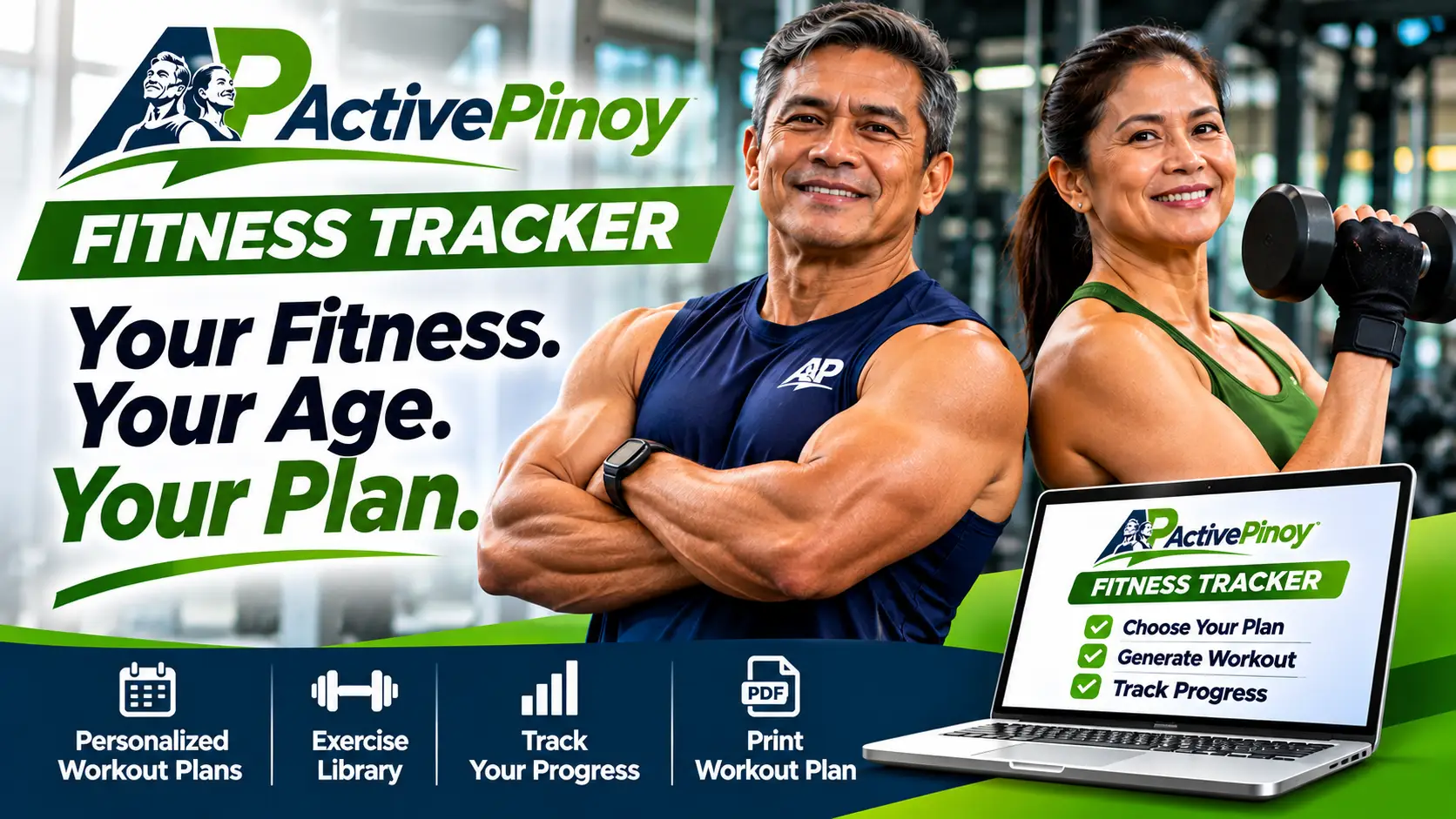
That’s why we developed the ActivePinoy Fitness Tracker, a free, browser-based fitness planning and workout tracking application designed with middle-aged and older adults in mind.
Whether you’re returning to exercise after several years, starting strength training for the first time, or already working out regularly, the ActivePinoy Fitness Tracker helps you organize your workouts and monitor your progress.
Try the ActivePinoy Fitness Tracker for Free
What Is the ActivePinoy Fitness Tracker?
The ActivePinoy Fitness Tracker is an online workout planning tool developed for adults who want to stay physically active, maintain muscle mass, and improve their overall fitness as they age.
Unlike generic workout generators that often emphasize bodybuilding or intense exercise routines, ActivePinoy places additional attention on healthy aging, recovery, mobility, and sustainable physical activity.
The application allows users to create workout programs based on several personal preferences, including:
- Age group
- Male or female profile
- Current fitness experience
- Primary fitness goals
- Available training days
- Home or gym exercise preferences
- Certain movement limitations or concerns
Based on these selections, the application generates a structured exercise program with suggested exercises, sets, repetitions, and workout instructions.
Users can also record workout information, including weights used and perceived exercise intensity.
The application runs directly in a web browser, so there’s no need to install a separate Android or iOS app.
Why We Created a Fitness App for Adults Over 40
Many workout programs available online are designed primarily for younger adults, competitive athletes, or experienced gym enthusiasts.
Although the fundamental principles of exercise apply across age groups, people in midlife and later adulthood may have different priorities.
Some want to rebuild muscle after years of inactivity. Others want to manage body weight, improve balance, maintain mobility, or remain independent as they grow older.
The ActivePinoy Fitness Tracker was created to make structured exercise more accessible to these individuals.
Its goal is simple: help more Filipinos exercise consistently, build strength, and maintain an active lifestyle for years to come.
Key Features of the ActivePinoy Fitness Tracker
1. Workout Programs for Different Age Groups
The application supports four age categories:
| Age Group | Training Considerations |
|---|---|
| 40–49 | Building strength, maintaining muscle, and developing consistent exercise habits |
| 50–59 | Preserving muscle, improving functional strength, and supporting recovery |
| 60–69 | Maintaining strength, mobility, balance, and physical independence |
| 70 and above | Supporting everyday movement, balance, functional ability, and appropriate resistance training |
These categories help organize workout recommendations, but age alone doesn’t determine a person’s capabilities.
A physically active 65-year-old may be able to perform more demanding exercises than an inactive 45-year-old.
That’s why the application also considers fitness experience, goals, and other selected preferences.
2. Fitness Programs for Men and Women
The ActivePinoy Fitness Tracker provides separate male and female profile options.
Both profiles use established exercise principles, including progressive resistance training, appropriate recovery, and gradual increases in training difficulty.
The distinction doesn’t mean women should automatically perform easier exercises or that men should always train with heavier weights.
Instead, the application aims to provide practical workout suggestions while allowing users to select programs that match their abilities and goals.
3. Personalized Workout Generation
One of the application’s main features is its ability to generate a structured workout schedule.
Users can select their preferred number of training days, from two to five sessions per week.
For example, someone in their 50s who is new to strength training might select a three-day weekly program.
Their schedule could include:
Monday — Full-Body Strength
- Squat or supported sit-to-stand
- Chest press
- Seated cable row
- Glute bridge
- Core exercise
Wednesday — Strength and Mobility
- Step-ups
- Lat pulldown
- Dumbbell shoulder exercise, where appropriate
- Hip-strengthening movement
- Mobility exercises
Friday — Full-Body Strength
- Leg press
- Dumbbell row
- Chest press variation
- Calf raises
- Core stabilization
This is an illustrative example rather than a guaranteed output from the app. Actual exercise selections depend on the user’s settings.
The important principle is to train major muscle groups regularly while allowing sufficient recovery.
4. Exercise Library With Instructions
The ActivePinoy Fitness Tracker includes an exercise library covering major movement patterns and muscle groups.
Exercises include strength-training movements, core exercises, mobility activities, and functional exercises.
Each exercise can include instructions and alternative movements.
This is especially useful for beginners who may be unfamiliar with exercise names or need an alternative to a particular movement.
5. Workout Logging and Progress Tracking
Improving fitness requires more than simply completing workouts.
Tracking exercise performance can help users understand whether they’re progressing.
The ActivePinoy Fitness Tracker allows users to record information such as:
- Exercise weights
- Workout completion
- Perceived exertion
- Training frequency
- Changes in recorded performance
For example, if you performed a dumbbell exercise using 5 kg weights several weeks ago and can now complete the same repetitions with 7.5 kg using good technique, that may indicate improved strength.
The application also supports RPE, or Rating of Perceived Exertion, which helps users estimate how difficult an exercise feels.
On a 1–10 scale, an RPE of 7 generally means the exercise feels challenging but several additional repetitions may still be possible.
This helps users regulate training effort without always pushing to maximum intensity.
6. Printable Workout Programs
Some people prefer bringing a printed workout program to the gym instead of checking their phone between exercises.
The ActivePinoy Fitness Tracker includes a Print / Save PDF function.
Users can generate a workout program and save a printable copy containing exercise information, sets, repetitions, and spaces for recording training performance.
This makes the app useful for both digital tracking and traditional workout logging.
7. Home and Gym Workout Options
Not everyone has access to a gym, and joining one isn’t necessary to begin improving physical fitness.
The application supports home and gym training preferences.
Depending on the selected program, workouts may include bodyweight exercises, resistance movements, and exercises using commonly available gym equipment.
Home training can be particularly helpful for beginners who want to establish an exercise routine before investing in equipment or a gym membership.
Why Strength Training Becomes More Important After 40
As people age, maintaining muscle mass and physical strength becomes increasingly important.
Age-related changes in muscle, physical activity, hormones, nutrition, and general health can contribute to reductions in muscle mass and performance over time.
However, these changes aren’t entirely unavoidable.
Research consistently shows that resistance training can improve muscular strength and physical function in middle-aged and older adults.
Strength training may help support:
- Muscle mass and muscular strength
- Everyday activities such as climbing stairs and carrying groceries
- Bone health
- Balance and physical function
- Metabolic health
- Long-term independence
The World Health Organization recommends that adults perform muscle-strengthening activities involving major muscle groups on at least two days per week.
For adults aged 65 and older, WHO also recommends multicomponent physical activity emphasizing functional balance and strength on three or more days weekly to help prevent falls.
These recommendations reinforce the importance of combining strength training with cardiovascular exercise, mobility, and balance activities.
How to Use the ActivePinoy Fitness Tracker
Getting started takes only a few minutes.
Step 1: Open the Application
Visit the ActivePinoy Fitness Tracker page:
The application works directly through your browser.
Step 2: Select Your Age Group and Profile
Choose the age group that matches your current age and select the male or female profile.
Step 3: Choose Your Fitness Experience
Select whether you’re a beginner, intermediate, or advanced exerciser.
If you haven’t exercised regularly for several months or years, starting with a beginner program may be appropriate even if you were previously physically active.
Step 4: Select Your Fitness Goal
Choose your main training priority, such as building muscle, improving strength, supporting mobility, or maintaining general fitness.
Step 5: Set Your Weekly Training Schedule
Choose how many days per week you can realistically exercise.
For beginners, two or three resistance-training sessions per week can be a practical starting point.
Step 6: Generate Your Workout Program
The application creates a workout schedule based on your selections.
Review the exercises and instructions before beginning.
Step 7: Track Your Workouts
Record the weights used, exercise effort, and completed sessions.
Over time, use these records to assess your progress and adjust training appropriately.
Is the ActivePinoy Fitness Tracker Suitable for Beginners Over 50?
Yes. The application includes beginner-friendly settings and exercise alternatives.
However, beginners should approach exercise gradually, especially after prolonged inactivity.
A practical starting strategy includes using manageable resistance, learning proper movement technique, allowing recovery between demanding workouts, and increasing exercise difficulty progressively.
People with existing injuries, significant balance problems, cardiovascular conditions, or other medical concerns may need individualized advice before beginning or changing an exercise program.
The app is a fitness planning tool, not a substitute for medical evaluation, rehabilitation, or professional supervision.
Can Adults Over 60 or 70 Still Build Muscle?
Yes.
Research shows that older adults can improve muscle strength and physical performance through appropriately designed resistance-training programs.
Although the rate of improvement varies, chronological age alone doesn’t prevent meaningful progress.
A beginner in their 60s or 70s may benefit from exercises such as supported sit-to-stands, resistance-band rows, wall push-ups, calf raises, and balance activities.
As strength and confidence improve, resistance and exercise complexity can be adjusted.
The objective isn’t necessarily to lift the heaviest possible weights. It’s to build the physical capacity needed to remain active, capable, and independent.
Frequently Asked Questions
Is the ActivePinoy Fitness Tracker free?
Yes. The ActivePinoy Fitness Tracker is offered as a free browser-based workout planning tool.
Do I need to download an app?
No. You can access the application directly through ActivePinoy.com using a compatible web browser.
Can women over 50 use the app?
Yes. The application supports male and female profiles and includes workouts suitable for different experience levels and fitness goals.
Can I use the app without going to a gym?
Yes. The application supports home workout preferences.
How many days per week should I exercise after 50?
For many adults, two or three weekly resistance-training sessions provide a practical starting point. The appropriate frequency depends on fitness level, recovery, goals, and health status.
Can I save my workout progress?
Yes. The application supports workout logging and progress tracking. In the current version, records are stored locally in the browser, so they may not transfer automatically between devices and can be lost if browser data is cleared.
Can I print my workout plan?
Yes. The application includes a Print / Save PDF function for generating printable workout documents.
Does the app replace a personal trainer?
No. The app helps organize workouts and track performance, but it cannot directly evaluate your exercise technique, diagnose injuries, or provide the same individualized supervision as a qualified trainer or healthcare professional.
Start Building Strength for the Years Ahead
Maintaining an active lifestyle becomes increasingly valuable as we get older.
Whether you’re 45 and returning to the gym, 55 and trying to rebuild muscle, or 70 and working to maintain mobility and independence, having a structured exercise program can make it easier to get started.
The ActivePinoy Fitness Tracker was developed to help Filipinos approach fitness with a practical, sustainable plan.
You don’t need to be an athlete, lift heavy weights, or spend hours exercising every day.
Start with an appropriate program, train consistently, and build on your progress.
Create Your Free Workout Plan With ActivePinoy Fitness Tracker
ActivePinoy Fitness Tracker is intended for general fitness education and planning. Exercise recommendations should be adjusted to individual abilities, health conditions, and professional medical advice where appropriate.
References and Further Reading
- World Health Organization. WHO Guidelines on Physical Activity and Sedentary Behaviour.
- Centers for Disease Control and Prevention. Physical Activity Guidelines for Older Adults.
- National Institute on Aging. Exercise and Physical Activity.
- Fragala MS, et al. (2019). Resistance Training for Older Adults: Position Statement From the National Strength and Conditioning Association. Journal of Strength and Conditioning Research. PubMed.
