You’ve probably heard it before: once you reach 50, your muscles start disappearing, your metabolism slows down, and getting back into shape becomes almost impossible.
It’s a familiar story, especially for people who spent most of their younger years working, raising families, and putting exercise somewhere near the bottom of their priorities.
But here’s something worth knowing: turning 50 does not mean your muscle-building years are over.
Whether you’re a 52-year-old office worker in Metro Manila, a 60-year-old preparing for retirement, or someone approaching 70 who wants to remain independent, your muscles can still respond to strength training.
You might not recover as quickly as you did at 25, and progress may require more patience. But getting stronger is absolutely possible.
In fact, building muscle after 50 is about much more than looking good in a T-shirt. It can help you climb stairs, carry groceries, maintain your balance, manage everyday activities, and enjoy an active lifestyle as you grow older.
So, is it too late to start lifting weights after 50? Let’s look at what science tells us and how you can begin safely—even if you’ve never entered a gym.
Can You Really Build Muscle After 50?
Yes. Older adults can gain muscle and improve strength through resistance training.
Your muscles retain the ability to adapt when they are challenged. This process involves increasing muscle protein synthesis and making other adaptations in response to exercise.
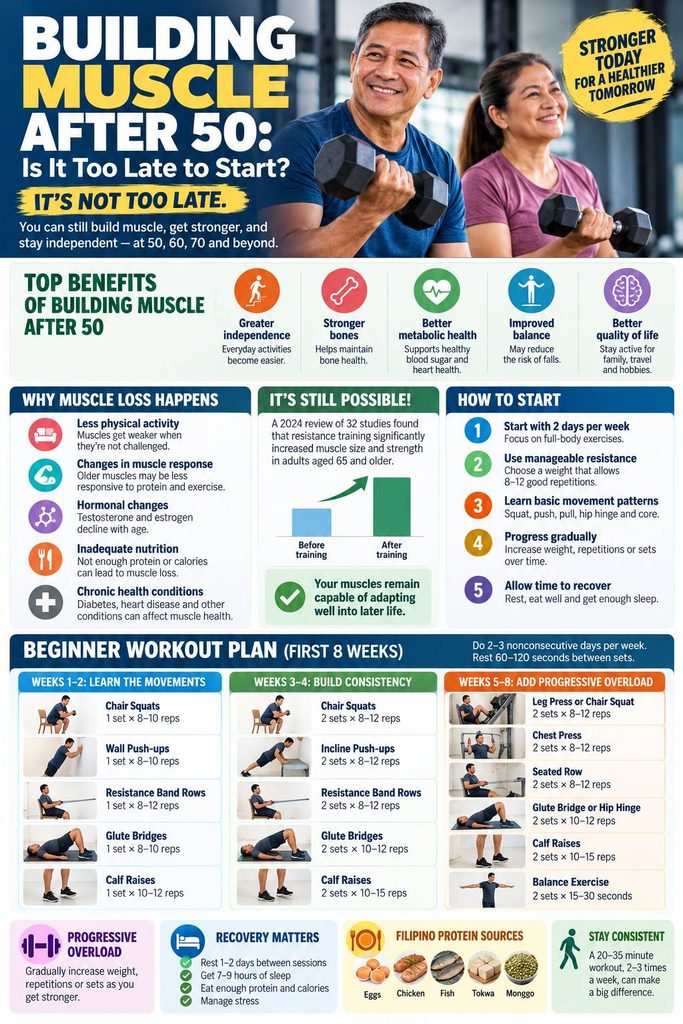
A systematic review and meta-analysis published in Experimental Gerontology in 2024 examined resistance-training studies involving adults aged 65 and older. It found that resistance training significantly increased muscle size and muscle fiber area.
That matters because it demonstrates that muscle growth remains possible well beyond middle age.
Older adults can also make substantial improvements in strength even when changes in visible muscle size are modest. Training improves not only muscle tissue but also the nervous system’s ability to activate muscles efficiently.
The important thing to understand is that age changes how you approach training. It doesn’t eliminate your ability to improve.
Why Muscle Loss Happens as We Get Older
Before discussing how to gain muscle, it helps to understand why we lose it in the first place.
One of the biggest challenges of aging is sarcopenia, a progressive muscle disorder involving reduced muscle strength and muscle quantity or quality.
Muscle loss can be influenced by several factors.
1. Less physical activity
Think about how much your daily routine may have changed over the years.
In your twenties, you might have walked more, played basketball on weekends, or spent more time moving around.
By your fifties, you may be spending eight hours sitting in front of a computer, driving instead of walking, and relaxing in front of the television after work.
Muscles adapt to the demands placed on them. When they’re no longer challenged regularly, they tend to become weaker.
2. Changes in muscle protein synthesis
As we age, our muscles may become less responsive to dietary protein and exercise.
This is sometimes called anabolic resistance.
It means older adults may need to pay closer attention to getting adequate protein and providing an appropriate exercise stimulus to maintain and build muscle.
3. Hormonal changes
Testosterone and estrogen influence muscle and bone health, and their levels can change with age.
But not every reduction in strength is caused by low testosterone or another hormonal problem.
Inactivity, insufficient food intake, poor sleep, medications, and underlying illnesses may also contribute.
Hormone treatment should only be considered when medically indicated following appropriate evaluation, not simply because someone has turned 50.
4. Inadequate nutrition
Some older adults eat too little protein or follow restrictive diets that make maintaining muscle difficult.
Others may lose their appetite or skip meals because of busy schedules.
Exercise creates the stimulus for muscle growth, but the body also needs sufficient energy and nutrients to respond.
Why Building Muscle After 50 Is Worth the Effort
If you’ve never been particularly interested in bodybuilding, you might wonder why you should bother lifting weights now.
The answer is simple: maintaining muscle helps maintain independence.
Everyday activities become easier
Getting out of a chair, lifting a suitcase, carrying groceries, and climbing stairs all require muscular strength.
When your muscles become stronger, many of these ordinary activities can feel less demanding.
You support better balance and mobility
Leg and hip strength contribute to stable movement.
When combined with balance exercises, strength training helps support physical function and can reduce the risk of falls.
You support metabolic health
Muscle tissue plays an important role in how the body uses glucose.
Regular resistance exercise can improve insulin sensitivity and help support blood sugar management.
This is particularly relevant for Filipino adults managing prediabetes or type 2 diabetes.
You maintain your ability to enjoy life
Imagine reaching retirement and having enough strength and stamina to travel, explore new places, spend time with grandchildren, or simply enjoy a long walk without excessive fatigue.
That is one of the most valuable reasons to preserve muscle as you age.
Do You Need to Join a Gym?
Not necessarily.
You can begin building strength using body-weight exercises, resistance bands, dumbbells, or exercise machines.
A gym provides access to more equipment and makes it easier to progressively increase resistance. However, effective training can also begin at home.
For example, if you live in a condo in Metro Manila and don’t have much space, a stable chair, a resistance band, and a pair of adjustable dumbbells may be enough for an introductory program.
What’s important is having exercises that challenge your major muscle groups and allow gradual progression.
How to Start Strength Training After 50
The biggest mistake beginners make is trying to do too much, too soon.
You don’t need to immediately copy the workout of someone who has been lifting for 20 years.
Your first goal should be to build consistency, learn proper technique, and allow your body to adapt.
Start with two days per week
The World Health Organization recommends muscle-strengthening activities involving all major muscle groups on at least two days per week.
For someone completely new to exercise, two full-body training sessions weekly are a sensible starting point.
After several weeks, you can consider increasing to three sessions if your recovery and schedule allow.
Choose manageable resistance
You should feel that your muscles are working, but you shouldn’t need to strain excessively or sacrifice technique to complete a repetition.
A useful beginner target is a weight that allows approximately 8–12 controlled repetitions while leaving two or three additional repetitions possible.
For people who are very deconditioned, even simpler movements with fewer repetitions may be appropriate initially.
Learn the basic movement patterns
A balanced routine should include:
- Squatting: Chair squats or leg presses for leg strength.
- Pushing: Wall push-ups or chest presses for chest, shoulder, and arm strength.
- Pulling: Resistance-band rows or seated cable rows for the back and arms.
- Hip movements: Glute bridges or supported hip hinges for the hips and posterior chain.
- Balance and core control: Supported balance exercises and appropriate core movements.
These patterns build the strength needed for both exercise and everyday life.
Beginner Workout Plan: Your First Eight Weeks
This program is designed for generally healthy adults aged 50 and older who are beginning resistance training.
It is an example, not a medical prescription. People with significant mobility limitations, existing injuries, or unstable health conditions may need individualized advice.
Weeks 1–2: Learn the movements
Train twice weekly, ideally with at least one rest day between sessions.
| Exercise | Sets | Repetitions |
|---|---|---|
| Chair squats | 1 | 8–10 |
| Wall push-ups | 1 | 8–10 |
| Resistance-band rows | 1 | 8–12 |
| Glute bridges | 1 | 8–10 |
| Supported calf raises | 1 | 10–12 |
Use slow, controlled movements and focus on technique.
Before each workout, warm up for five to ten minutes with comfortable walking and gentle joint movements.
Rest as needed between exercises. Around 60–120 seconds is a reasonable starting point, although some people will need longer.
Weeks 3–4: Build consistency
Continue training twice per week.
If the exercises feel comfortable and your recovery is good, progress toward two sets per movement.
| Exercise | Sets | Repetitions |
|---|---|---|
| Chair squats | 2 | 8–12 |
| Incline or wall push-ups | 2 | 8–12 |
| Resistance-band rows | 2 | 8–12 |
| Glute bridges | 2 | 10–12 |
| Supported calf raises | 2 | 10–15 |
You may begin noticing that certain exercises are becoming easier. That is a positive sign, even if you don’t see visible changes in muscle size yet.
Weeks 5–8: Introduce progressive overload
Continue with two sessions or add a third nonconsecutive training day if you are recovering well.
You can also begin using gym machines or dumbbells where appropriate.
| Exercise | Sets | Repetitions |
|---|---|---|
| Leg press or chair squat | 2 | 8–12 |
| Chest press or incline push-up | 2 | 8–12 |
| Seated row | 2 | 8–12 |
| Glute bridge or supported hip hinge | 2 | 10–12 |
| Calf raises | 2 | 10–15 |
| Supported balance exercise | 2 | 15–30 seconds |
Increase resistance only when the current level feels manageable and you can complete the prescribed repetitions without compromising your technique.
There is no need to increase weights every session.
Understanding Progressive Overload After 50
If there’s one principle you should understand about building muscle, it’s progressive overload.
Progressive overload means gradually making an exercise more challenging as your body becomes stronger.
Here’s a practical example.
Suppose you’re 55 and have just started using a chest press machine at your local gym.
- Week 1: You use 10 kg for eight controlled repetitions.
- Week 2: You use the same weight for ten repetitions.
- Week 3: You manage twelve controlled repetitions.
- Week 4: If your technique remains good, you try the next small available weight increase and work toward eight controlled repetitions again.
This is an illustrative progression, not a schedule you must follow. Some people will progress faster, while others need more time at the same resistance.
You can also progress by improving movement quality, increasing range of motion where safe, or adding another set.
For adults over 50, a gradual approach is usually preferable to pushing for heavier weights regardless of fatigue or discomfort.
What If You’re Already 60 or 70?
The basic principles remain the same.
Appropriate resistance exercise can improve muscle strength and function even in older age groups.
However, people in their sixties or seventies may have different needs depending on their health, training experience, balance, and physical limitations.
Someone who has exercised regularly for decades may be comfortable using challenging weights.
Someone who has been inactive for 15 years may need to begin with assisted chair exercises and supervised movement.
Neither starting point is wrong.
The important thing is to begin at a level that matches your present abilities rather than comparing yourself with other people.
Recovery After 50: Why Rest Matters
It’s tempting to think that training more often automatically means building more muscle.
But muscles need time to adapt to training.
Recovery becomes particularly important if you’ve spent years being inactive or are returning after an injury.
Allow time between demanding workouts
If you’re following a full-body program, training on Monday and Thursday or Monday, Wednesday, and Friday can provide recovery opportunities between sessions.
You can still stay active on other days with comfortable walking, mobility exercises, or other suitable activities.
Get enough sleep
For most adults aged 50–64, seven to nine hours of sleep is a reasonable target. Adults aged 65 and older generally need around seven to eight hours.
Sleep supports recovery, daily functioning, and general health.
If you’re waking up exhausted every day, your sleep habits deserve attention alongside your training routine.
Eat enough to support recovery
Protein helps repair and maintain muscle tissue, while sufficient overall food intake supports energy needs.
Older adults who exercise regularly should pay attention to protein intake, especially if they’re also trying to lose weight.
A practical way to begin is to include a protein source at each main meal.
In the Philippines, affordable options include:
- Eggs
- Chicken
- Tilapia, bangus, and other fish
- Tokwa
- Monggo and other legumes
- Milk, yogurt, and other appropriate dairy foods
For healthy older adults, expert groups often recommend protein intake above the standard adult minimum, but the appropriate amount depends on individual health and activity levels.
People with kidney disease or medically prescribed protein restrictions should seek individualized nutrition advice before increasing protein intake substantially.
Know the difference between soreness and pain
Mild muscle soreness after an unfamiliar workout is common.
Sharp pain, joint instability, radiating pain, numbness, or worsening weakness are different.
Stop the provoking exercise and seek appropriate assessment, particularly if neurological symptoms or weakness occur.
Chest pain, fainting, or severe shortness of breath during exercise requires urgent medical attention.
Can You Build Muscle While Losing Belly Fat?
Many Filipino adults over 50 want to become stronger while reducing abdominal fat.
In certain circumstances, both goals can be pursued at the same time.
This process is often called body recomposition.
Beginners and people returning to strength training after a long break may be particularly well placed to improve muscle and body fat simultaneously, although individual results vary.
The key is to avoid extreme dieting.
If you eat too little while exercising hard, you may find it difficult to recover and preserve muscle.
Instead, focus on:
- Regular resistance training.
- Appropriate protein intake.
- A balanced diet with sufficient nutrients.
- Walking and other cardiovascular activities.
- A manageable calorie deficit if fat loss is medically appropriate.
- Adequate sleep and recovery.
And remember, doing hundreds of sit-ups won’t specifically remove belly fat. Abdominal exercises strengthen muscles, but fat loss depends on broader changes in energy balance and lifestyle.
Common Mistakes Beginners Make After 50
Starting too aggressively
You don’t need a five-day bodybuilding split in your first month. Begin with a manageable workload, establish good technique, and progress gradually.
Using too little resistance forever
Very light weights are useful for learning movements, but your muscles need an appropriate challenge to keep getting stronger.
Skipping leg training
Leg and hip strength are especially important for walking, climbing stairs, and maintaining independence.
Don’t focus exclusively on your arms and chest.
Ignoring nutrition
Even a well-designed workout cannot compensate for consistently inadequate nutrition.
Make sure your meals provide enough energy and protein to support your goals.
Comparing yourself with younger gym members
Your progress should be measured against your own starting point, not someone else’s lifting numbers.
Adding two repetitions to an exercise or climbing stairs more comfortably is meaningful progress.
Expecting visible changes immediately
Strength improvements may appear before substantial increases in muscle size.
Consistent training over several months is more important than what happens during the first few workouts.
What About High Blood Pressure, Diabetes, or Joint Problems?
Many adults over 50 live with hypertension, diabetes, arthritis, or other medical conditions.
These conditions do not automatically prevent strength training. However, they can affect exercise selection, intensity, and medical precautions.
For example:
- Hypertension: People with controlled blood pressure can often exercise, but uncontrolled blood pressure or concerning symptoms require medical evaluation. Avoid unnecessary breath-holding while lifting.
- Diabetes: Resistance training may help blood glucose control. People taking medications that can cause hypoglycemia may need specific glucose-monitoring precautions.
- Arthritis: Exercise modifications can help strengthen muscles without unnecessarily aggravating painful joints.
- Back or shoulder problems: Some exercises may need to be replaced or supervised, particularly when numbness, radiating pain, or weakness is present.
If you have a significant medical condition, unstable symptoms, or an injury that limits movement, discuss an appropriate exercise program with a clinician or physical therapist.
For most otherwise healthy adults beginning low-intensity activity, extensive medical testing is not routinely necessary. The goal is to match exercise to your individual risk and capacity.
How Long Before You Notice Results?
There’s no universal timeline for muscle growth.
Age, training history, sleep, nutrition, exercise consistency, and health conditions all influence the response.
However, here’s a reasonable illustration of what beginners may experience.
| Training period | Possible changes |
|---|---|
| Weeks 1–2 | Learning technique, improved confidence, and better movement control |
| Weeks 3–4 | Exercises may feel easier; some early strength improvements |
| Weeks 5–8 | Improved strength and ability to handle additional repetitions or resistance |
| Weeks 9–12 | Continued strength improvements; some people may notice changes in muscle size |
| Months 4–6 | More meaningful improvements in physical function and potentially body composition |
These are examples, not guaranteed milestones.
You might notice everyday improvements before you see dramatic differences in the mirror.
Walking uphill, carrying shopping bags, or standing up from a low chair may gradually become easier.
How to Stay Consistent When Life Gets Busy
Many Filipinos in their fifties are still working full-time, supporting family members, or preparing financially for retirement.
Finding time to exercise can be difficult.
But strength training doesn’t have to consume your entire day.
A beginner workout can sometimes be completed in about 20–35 minutes, depending on the number of exercises, sets, and rest periods.
Consider these simple approaches:
- Schedule two exercise days each week as regular appointments.
- Use a nearby gym or a small home workout area to reduce travel time.
- Keep a record of your repetitions and resistance.
- Prepare simple protein-rich meals in advance.
- Choose activities you can continue rather than an aggressive program you’ll abandon after two weeks.
Consistency doesn’t mean never missing a workout.
It means returning to your routine after interruptions and gradually building a habit you can maintain.
Frequently Asked Questions
Is 50 too old to start lifting weights?
No. People can begin resistance training after 50 and improve muscular strength, physical function, and potentially muscle size. Start with manageable exercises and progress gradually.
Can a 60-year-old beginner build muscle?
Yes. Research shows that resistance training can stimulate muscle growth in adults aged 65 and older. Results depend on training consistency, nutrition, health, and individual responses.
Do beginners over 50 need heavy weights?
No. Beginners should initially use resistance they can control safely. As their technique and strength improve, resistance can gradually increase.
How many times per week should I lift weights?
Two days per week is a sensible starting point. Many people later progress to three full-body sessions weekly, depending on their fitness, recovery, and schedule.
Can I gain muscle using resistance bands?
Yes. Resistance bands can provide a useful training stimulus, especially for beginners. To continue progressing, you may eventually need stronger bands or more challenging exercise variations.
Should I work out every day to gain muscle faster?
No. Daily strenuous full-body resistance training is unnecessary for beginners. Recovery between challenging sessions helps your body adapt.
Is walking enough to build muscle after 50?
Walking is excellent for general fitness and mobility, but progressive resistance exercise provides a more direct stimulus for increasing strength and muscle size.
Do I need protein powder or creatine?
Neither is essential. Protein powder can be convenient if dietary protein is insufficient, while creatine may offer benefits for some people when combined with resistance training. Discuss supplements with a healthcare professional if you have relevant medical concerns.
Can women build muscle after menopause?
Yes. Women can improve muscular strength and muscle mass after menopause through appropriate resistance training, sufficient nutrition, and recovery.
What if I have never exercised in my life?
Start with basic movements such as chair squats, wall push-ups, and resistance-band rows. Build gradually and get professional guidance if you have health conditions or mobility concerns.
Final Thoughts: Your Strongest Years May Still Be Ahead
There is no denying that aging changes the body.
You may not recover as quickly as you once did. You may need more attention to nutrition, sleep, and exercise technique. Progress might be slower than you would like.
But none of that means you should stop trying.
In fact, strength training becomes increasingly valuable as you grow older because it supports the physical abilities you want to preserve.
You don’t need to look like a professional bodybuilder.
You don’t need expensive supplements, a complicated program, or hours inside the gym.
You need a sensible starting point, a little patience, and a routine you can continue.
Begin with two workouts a week. Learn the movements. Increase resistance gradually. Eat well. Give yourself time to recover.
And most importantly, measure success by what your body can do—not just what it looks like.
Because building muscle after 50 isn’t about trying to become 25 again. It’s about becoming stronger for the years still ahead.
Sources and Further Reading
- World Health Organization. Physical Activity Recommendations. Guidance on aerobic and muscle-strengthening activities.
- National Institute on Aging. Tips for Getting and Staying Active as You Age. Practical exercise advice for older adults.
- Lower Extremity Muscle Hypertrophy in Response to Resistance Training in Older Adults. Experimental Gerontology, 2024. View systematic review.
- Global Consensus on Optimal Exercise Recommendations for Enhancing Healthy Longevity in Older Adults. View consensus recommendations.
- American College of Sports Medicine. Resistance Training Prescription for Muscle Function, Hypertrophy, and Physical Performance in Healthy Adults: An Overview of Reviews. View position stand.
- Centers for Disease Control and Prevention. Older Adult Activity: An Overview.
- Philippine Clinical Practice Guidelines for Periodic Health Examination: Lifestyle Interventions for Adults and Adolescents. View Philippine clinical guidelines.
Medical disclaimer: This article provides general health and fitness information and is not intended to replace medical evaluation or individualized exercise advice. Consult an appropriate healthcare professional if you have unstable medical conditions, significant exercise limitations, or symptoms that may indicate an injury or other health problem.